
by Emily Rinaman, Catalog Librarian
One of the most important tools for a genealogist researching family history is a name, and it doesn’t have to be spelled correctly. In fact, it’s helpful to stay open to alternate spellings of both an ancestor’s given name and surname. While surnames can last for centuries, the popularity of first names changes with the generations. Names that were once popular in Victorian times became outdated. Trends like naming, though, have a way of circling back around. Especially in the case of naming children, traditional family names are often given to new family members when they are born.
In this month’s blog, we are exploring the naming conventions of different cultures and have chosen a few examples of former Seneca County residents as examples of these trends.
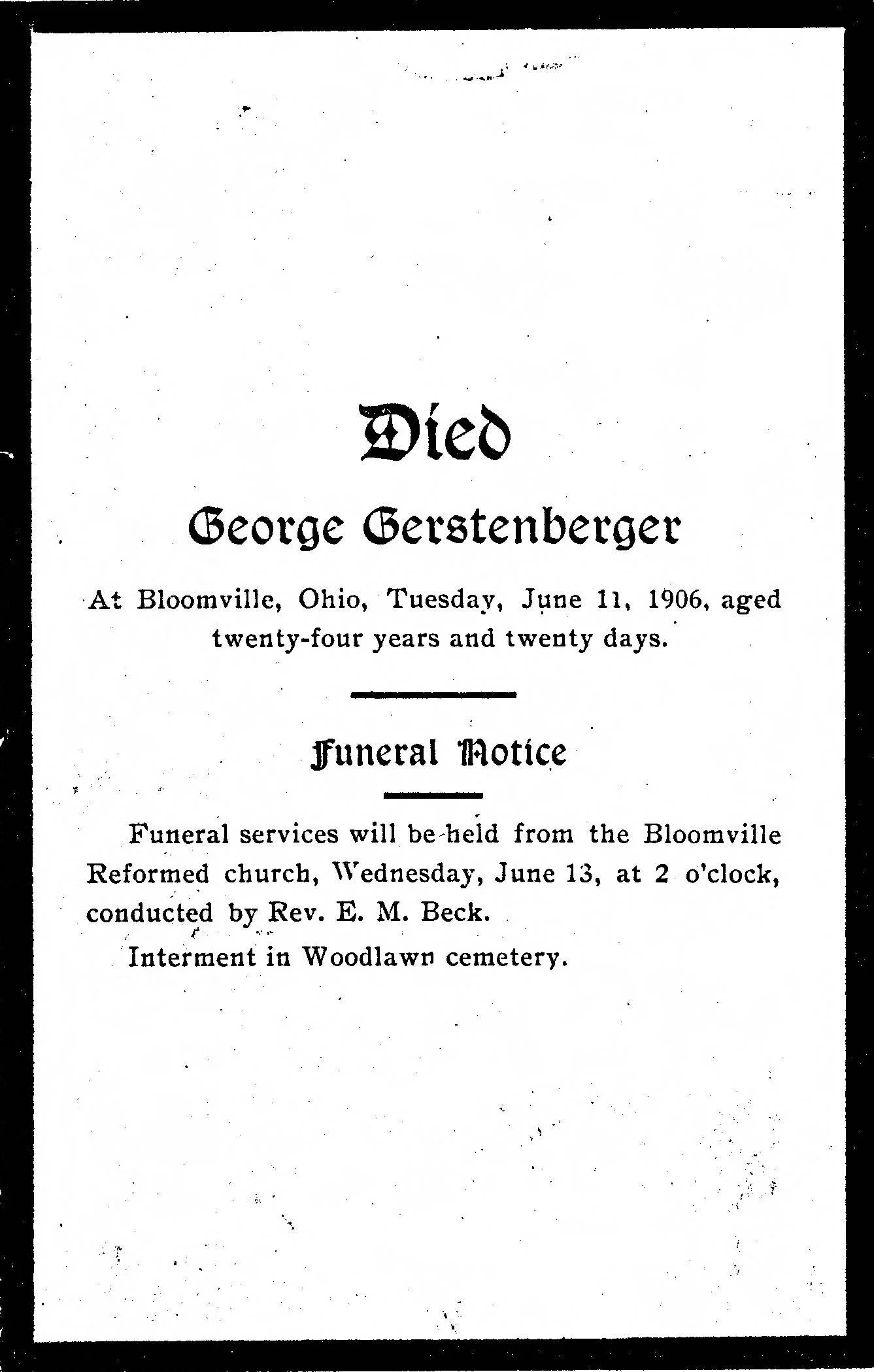
An obituary for George Gerstenberger from the Bloomville Funeral Notices digitized on the SCDL. In German, the surname Gerstenberger translates to "a barley field on a hill."
An overwhelming majority of residents in Seneca County have ethnic connections to Germany and its border countries like Belgium, France, Luxembourg, Switzerland, and the Netherlands. There are many similar naming trends between these European countries as those cultures began blending together more and more over time.
One common trend is for people to be named after their occupation, which traditionally was carried on and taught to the next generation (and so on). For example, some common surnames in Seneca County with German roots elude to those families having coming from agricultural trades. The name “Hoffmann” is the Middle High German version of “farmer.” Likewise, “Hoover,” which is an Americanized version of “Huber,” which is an Old High German word for “a plot of land.” The surname variant “Aker” or its German equivalent, “Ackermann,” translates to a person who “lived next to a field.”
Other trades that are represented in surnames in Seneca County include Zimmerman (“carpenter” in Middle High German), Ziegler (“bricklayer in Middle High German), Snyder (“tailor”), and Kalbfleisch and Metzger (“butcher”). Cramer and Kaufmann are general names for merchants or shopkeepers, while other surnames come from more specific trades and are based on the particular goods those individuals sold.
In Holland/The Netherlands, families were known by the name of the farm on which they lived.
All of these names have multiple spellings for multiple reasons. Many of the immigrants who arrived in Seneca County throughout the 1800s did not know how to read or write. They spelled words and even their own names phonetically. Hoffman and Huffman, Cramer and Kramer, and Snyder and Schneider – they all derive from one standardized German or Swiss form.
Some families who claim German heritage may also have French roots, especially if their ancestors originated in the area of the French and German borders, which at times in European history were contested as the two countries fought for the territory. The smaller countries of Luxembourg and Belgium also got caught into territorial wars.
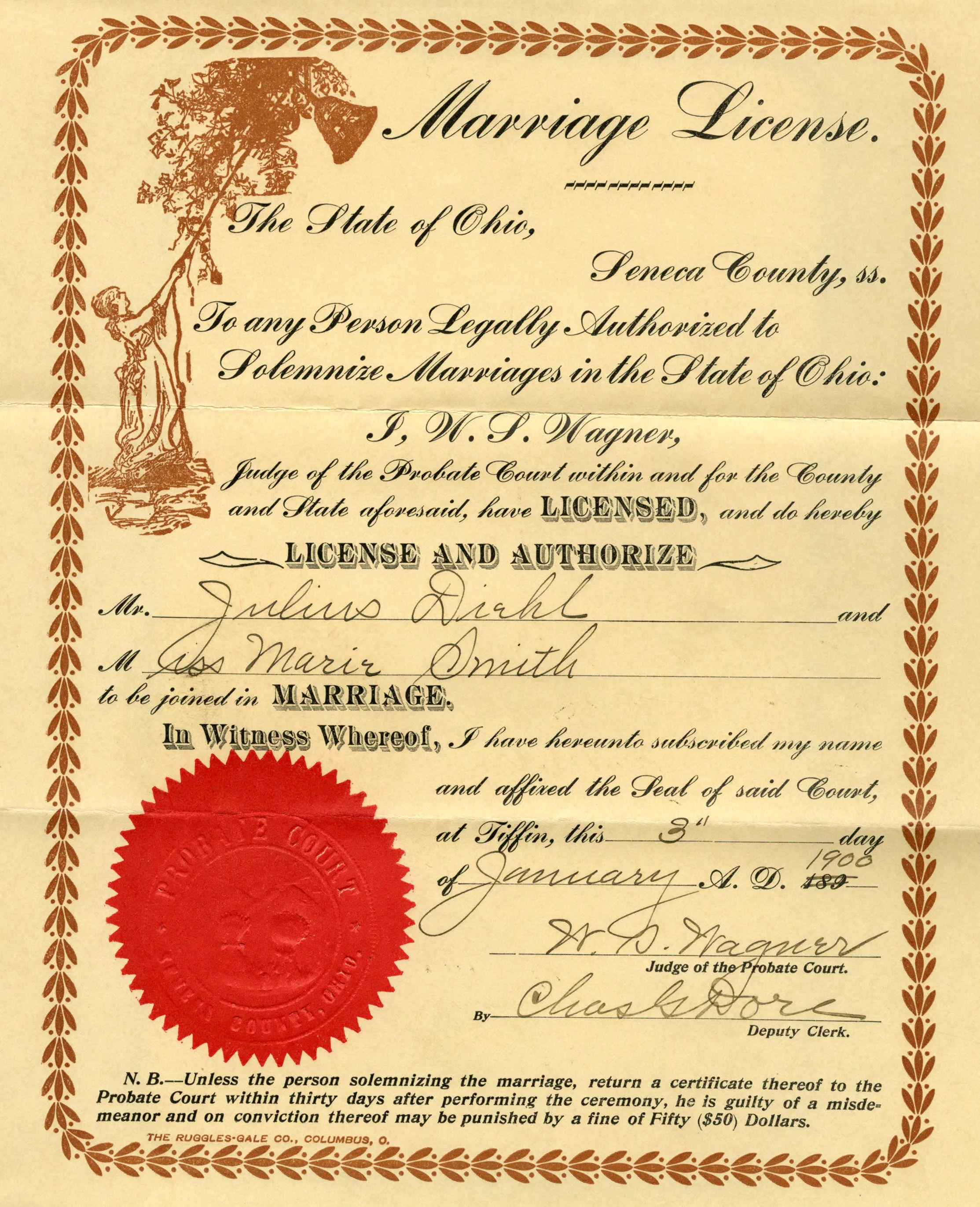
The marriage license for “Julius Diehl” and his wife. Latinized names were often given and used on records for people with French and German ancestry.
Names with Latin influence suggest that these families either originate from these areas in Western Europe or have had some ancestor with ties to an area other than strictly France or Germany. Latin was also the language in which names were recorded in official documents, such as immigration records.
“These names are not just labels, but embodiments of history, traits, and aspirations that resonate with French parents and the values they wish to bestow upon their children. These surnames are not just labels inherited by birth; they are storied maps tracing the lineage of families to particular locales and trades,” states Polina Ivanova in an article on the I-Lab Academy website.
In Greece, the ending of surnames provides clues to where a person is originally from. Those whose surnames end in “poulos,” like Samuel and William Asimakopoulos who were naturalized in Seneca County in the early 1920s, or the Stavropoulos family, most likely came from the Pelenponnese region. Or Anthony and Ruth Pavlakos, who with a surname ending in “akos,” may have deep roots in the Crete region.
First names are often giveaways, as well. Perusing through the marriage licenses which have been digitized on the Seneca County Digital Library, one will eventually find one for an “Augustin”, which is the French version of the Latin “Augustus.” In addition, there’s licenses for “Julius,” and “Valentin.” In the several volumes of naturalization records that have also been digitized for the SCDL, names like “Emile Constantin” (a witness for a naturalized citizen) suggest a French-Latin connection.
Other ethnicities, including Germany, but particularly Polish, tended to name themselves after the region or landscape in which they inhabited. The suffix “ski” at the end of a surname is an indication that whatever precedes the “ski” relates to a village town or other place in Poland (or surrounding countries) where that family originated.
In the naturalization records, Seneca County recorded immigrants from Burzyn, Poland (“Burzynski”), from Kopiec, Poland (“Koptzenski”), from Kruszyn (“Kruszynski”) and so on.
Names were borrowed much more often in previous centuries. It was much more common for infants when they were born to be given the name of a family member. In some cultures, surnames are based on the name of the father. First names were often just as important when identifying someone as surnames. Italian immigrants Dominic De Bernard and Antonio De Vincenzo, who both came to Seneca County in the early 1900s, were “of” men named Bernard and Vincenzo..
From the Scandinavian countries of Sweden, Norway, and Denmark, Seneca County received immigrants with the surnames AndersonAndersen (son of Andrew), Erickson (son of Eric), Hanson (son of Hans), Johnson (son of John), Karlson (son of Karl), Nelson, Christensen, Peterson/Pedersen and even Genssen.
If you are at all interested in the members of your family tree and how they got their names or what their names might mean, check out https://www.behindthename.com/name/. I used it for some ancestors in my own family tree. Results will state the Gender form, usage, pronunciation, meaning/history, related names and spellings, name days and what people think of the name in adjectives and popularity by decade. It has a search bar where you can type any surname in you want, and you can also browse by continent and ethnicity.
From using this website I learned that the surname “Jost,” or the Anglicized “Yost,” which many Seneca County residents can trace their lineages back to the same individuals with this last name who settled in the New Riegel and Alvada region, is German for “Joyce” and is common in Slovenia. In Medieval French it would have been spelled “Josse” and in Dutch it’s spelled “Joost”. It’s origins can be traced to medieval Breton where it derives from a Latin form of the word “ludocus”.
Works cited:
Behind the Name. https://www.behindthename.com/name/
Family Search. “Greece Naming Customs.” https://www.familysearch.org/en/wiki/Greece_Naming_Customs
Hoitink, Yvette. “Eight Dutch naming patterns to watch out for. Nov. 27, 2020. Dutch Genealogy. https://www.dutchgenealogy.nl/8-dutch-naming-patterns-to-watch-out-for/
Invanova, Polina. “French Names: exploring the charm and traditions of names in France.” ILab Academy. https://ilab.academy/en/french-names/
Lauer, Nancy Waters. “She has the same name is she her sister? : Naming conventions of our ancestors”. https://www.scchgs.org/documents/meetinghandouts/German_Naming.pdf
Marriage Licenses, Seneca County Digital Library. “People.” https://www.ohiomemory.org/digital/collection/p15005coll27/search/searchterm/People/field/subjec/mode/exact/conn/and
Seneca County Naturalization Records, 1834-1930. Seneca County Digital Library. https://ohiomemory.org/digital/collection/p15005coll27/id/58204
Seneca County Genealogical Society. “Seneca County Ancestor Charts.” October 5, 1985. https://ohiomemory.org/digital/collection/p15005coll27/id/41378