by Jessica Hoehn, Local History and Genealogy Specialist
Many soldiers of the Revolution left their hometowns after the war for new areas to lay down roots. Some of these soldiers eventually found their way to Ohio, often bringing their families with them to settle in the (at the time) new state. This year, we’ll take a look at the soldiers who settled in Seneca County and learn more about them.
This May, we’ll be learning about Francis Ditto/Franz Dido. His surname can also be spelled several more ways, including ‘Dittoe’ in records. Many of the records for Francis’ early life have sadly been lost to time and cirucmstance, so we have pulled family lore, histories, and sibling records to try and piece together some of this veteran’s history.
Born 1758 in Harrisburg, Pennsylvania (some time in September according to popular belief), Francis was orphaned at a young age. It is believed that his father was Joseph DeToe, a man who immigrated to Pennsylvania from Strassbourg, located in the Alsace region of what is now France. Francis’ mother, Barbara, appears to have died 1772, leaving him and his 7 siblings to be raised by guardians.
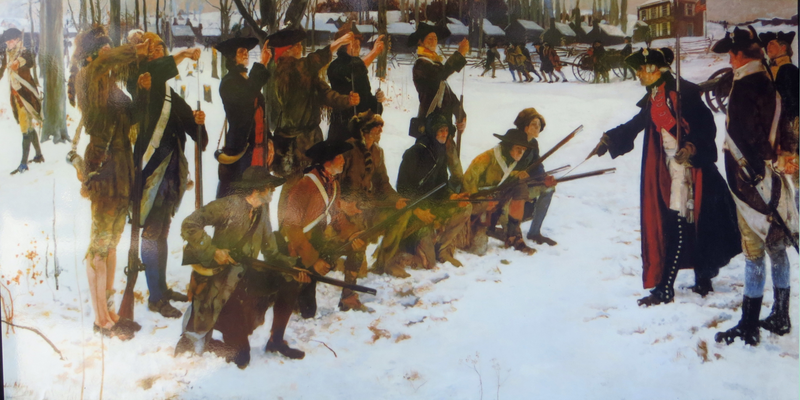
Baron Steuben training Continental Army troops at Valley Forge in 1778, depicted in a portrait by Edwin Austin Abbey.
Francis most likely enlisted in January of 1778 in McAllister’s Town, York County, Pennsylvania (the modern day borough of Hanover). When signing up with his twin brother Jacob, he and many others were told by recruiting officers that they would be made Sergeants of Horse. When it was revealed that, in fact, they would all be made privates, Jacob and other recruits quickly deserted. According to pension testimony, Jacob tried to convince Francis to leave as well.
“ …[Jacob] earnestly suggested me to do the same but I concluded my services were so much needed at that time that I would serve my time…”
So Francis stayed on for a term of three years as a private in the 2nd Pennsylvania Regiment under command of Col. Stewart and Captains Roby and Storey. After enlistment, he was one of the many who spent those cold winter months of early 1778 in Valley Forge, enduring the supply shortages that the army experienced there. After leaving the camp, Francis marched with his regiment to engage in the Battle of Monmouth. The day after the battle, he remarked that he helped bury the dead, and that the “heat killed men that day”.
In the second winter of his service, Francis was taken prisoner by the British at Newark, and taken to one of the the infamous Sugar Houses in New York City where he was imprisoned for three months. There were several buildings and churches in NYC which were gutted by the British and turned into prisons for captured soldiers. Those imprisoned there faced notably poor conditions, with many men dying while awaiting release. During the nights, Francis was kept in what he believed was a Quaker church, from which he attempted to escape.
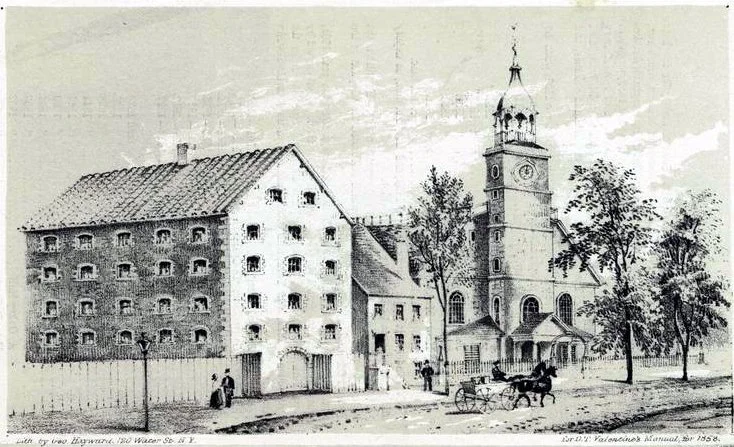
A depiction of the Livingston Sugar House (Left), one of the NYC prisons where Francis may have been kept.
“…while in the church we undertook to make our escape. We dug a hole under the wall of the church and under the pavement, (I remember 9 weeks with a hog’s jaw bone) when we had all things ready waiting for a dark night, a Hessian boy who had previously deserted from the British and joined the Americans, and had been taken prisoner by the British (I suppose to make his peace) discovered to the
British our woodchuck hole.”
While Francis did not manage to make his daring escape, he was shortly after released through a prisoner exchange, and rejoined the troops at Fredericksburg, Virginia. Later, he noted that he was stationed at West Point, mounting the cannons there when General Anthony Wayne took Stony Point. He then eventually wintered at White Plains and Fredericksburg, and at one point witnessed the hanging of British spies.
During the war, Francis noted that he was severely injured when working a baggage wagon, in which his hip joint became “completely destroyed” and he became crippled, though this did not stop him from continuing on in his service.
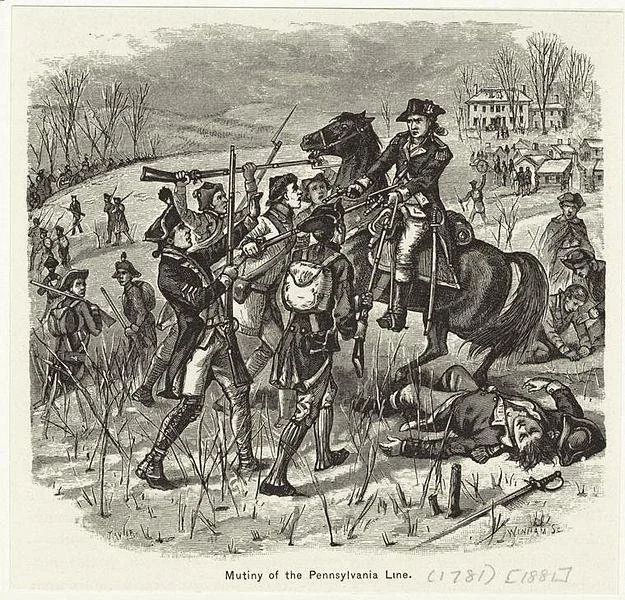
Woodcut of a scene in the Pennsylvania Line Mutiny (1881) / New York Public Library, Wikimedia Commons.
Before his three years were up, Francis was witness to the Pennsylvania Line Mutiny against General Wayne. Soldiers whose terms had expired, yet had not received their discharge orders, rose up against Col. Stewart and General Wayne, the former of whom was driven out of camp at bayonet-point. Francis, for his part, claimed he took no part in the revolt, and because of the incident received his discharge orders two weeks earlier than scheduled in Princeton.
After his service, Francis moved to Northumberland County, Pennsylvania, where he stayed for about 30 years. It was most likely there that he met and married his wife, Eleanor Gift around the fall of 1782. While living in Pennsylvania, an interesting story was passed down to the modern day. Francis had a habit of storing his apples in a pit and covering them with straw and dirt to keep them from freezing through the winter. At one point, the family realized someone had been stealing their apples, and Francis set up a steel trap to catch the thief. The next morning, the thief was caught red-handed, stuck with an arm in the pit, and asked to be let go as he was freezing in the cold. Francis replied that “I have not time now, I must go to the barn to feed my stock.”, and only after this chore was done did he come to free the man, telling him, “We have plenty of apples you could have had for the asking, but I don’t want them stolen. I will give you a bushel in your bag as a compensation for detaining you so unceremoniously at my apple hole. If you come back again for apples without permission, I will fill you full of buckshot…”
Together, Francis and Eleanor lived for years in Pennsylvania, and potentially had five children before the Dittos made their fateful move out west to the Ohio country in the 1810s. According to more family lore, before they left Pennsylvania, Francis had sold all the family’s land and many of their belongings, ending up with $700 in gold and silver. On the evening the Dittos left the area, they were receiving well wishes from neighbors, when part of a fence nearby was found to be on fire. Francis, realizing that it may be a ploy to steal the family’s money, stayed behind to guard it with his rifle while the rest of the family battled the flames.
With the potential crisis averted, the Dittos set off for Ohio. There, they settled in Washington Township of Pickaway County for 15-17 years, living and farming on 165 acres of land. Eventually, probably in the early 1830s, the pair moved to Seneca County, where their sons George and John had purchased land in Eden Township. One of their daughters, Catherine, also lived in Eden Township on a farm with her husband George Markley.
It’s here that Francis applied for his pension while living in Clinton Township, which he was approved to receive payments for starting March 4, 1831. After this, the couple may have stayed in Clinton, though we don’t have any land records on hand, or stayed with one of their sons.
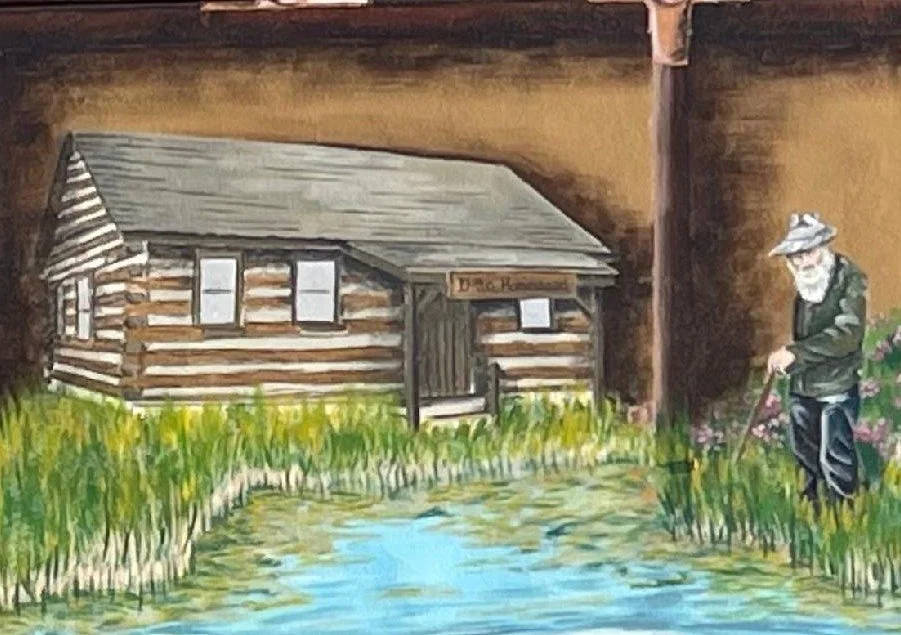
A depiction of George Ditto’s cabin in Archbold, Ohio, taken from a mural for the village painted by Dave Rickerd.
Francis died June 25, 1841 in Eden Township, and his burial is somewhat of a mystery. Many sources offer different cemeteries and farms he may have been buried on, but it is this author’s belief that one of his descendants, Hulda Schlapfer, is probably the closest to the truth. She claims that he was buried on a farm he lived on in Eden Township, near Tiffin. Specifically, she says that his grave, which was once marked with a stone, overlooked Mohawk Road. It is in that area, the 5th and 6th sections of Range 15 that surround what is now OH 231, that Francis’ sons George and John owned land. Francis Ditto may very well be buried out there, so close to our city’s borders.
After her husband’s death, Eleanor moved in with her daughter Catherine and applied for a widow’s pension, which she received on March 4, 1848. She was buried there on their farm after dying on March 1, 1855 at the age of 96. Her stone was eventually removed to Wauseon Union Cemetery near Archbold, Ohio, which her son George was the first to settle in 1838.