
by Emily Rinaman, Catalog Librarian
“What do you do (for a living)?” is a question that often gets asked by others when they are wanting to get to know you. It seems that what you do as a career somewhat defines who you are as a person. There are many obsolete jobs that once defined people even just decades ago and this month America-250 Ohio is celebrating the many occupations that our predecessors once aspired to.
Sometimes job titles change but the tasks stay the same. For example, a tin peddler was a type of salesperson. A teamster was like a chauffeur of sorts. Likewise, a sawyer was a carpenter, or in today’s terms, would fall under the umbrella of construction.
There are websites of lists dedicated to information about all sorts of obsolete jobs, like haberdasher, drayman, chimney sweep, town crier, chamber maid, and others, but in this month’s blog we will focus on a few that show up in documents digitized on the Seneca County Digital Library (SCDL).
In Bascom, a tin peddler would arrive once a year, according to the “Bascom: Then and Now” booklet on the SCDL. “He drove a single horse hitched to a surrey-like wagon from which dangled tin cups, buckets, dippers, milk strainers, colanders, pot and pans, and anything else he could find made of tin,” states the booklet.
According to Professor Malcom Keir at the University of Pennsylvania, tin peddlers originated in colonial Connecticut. Once all the farmland was bought up by settlers, the rest of society had to find other ways to make a living, so tin peddlers found a niche selling all things tin.
Tin peddlers typically sold their tinware in the warmer months when the dirt roads weren’t as muddy so their wagons wouldn’t get stuck. The Bascomites said, “When the birds started south, so did the tin peddler. Then came the grand finale when our peddler unwrapped-almost reverently-the silks from his beloved Damascus. We could not buy but the looking was free.”
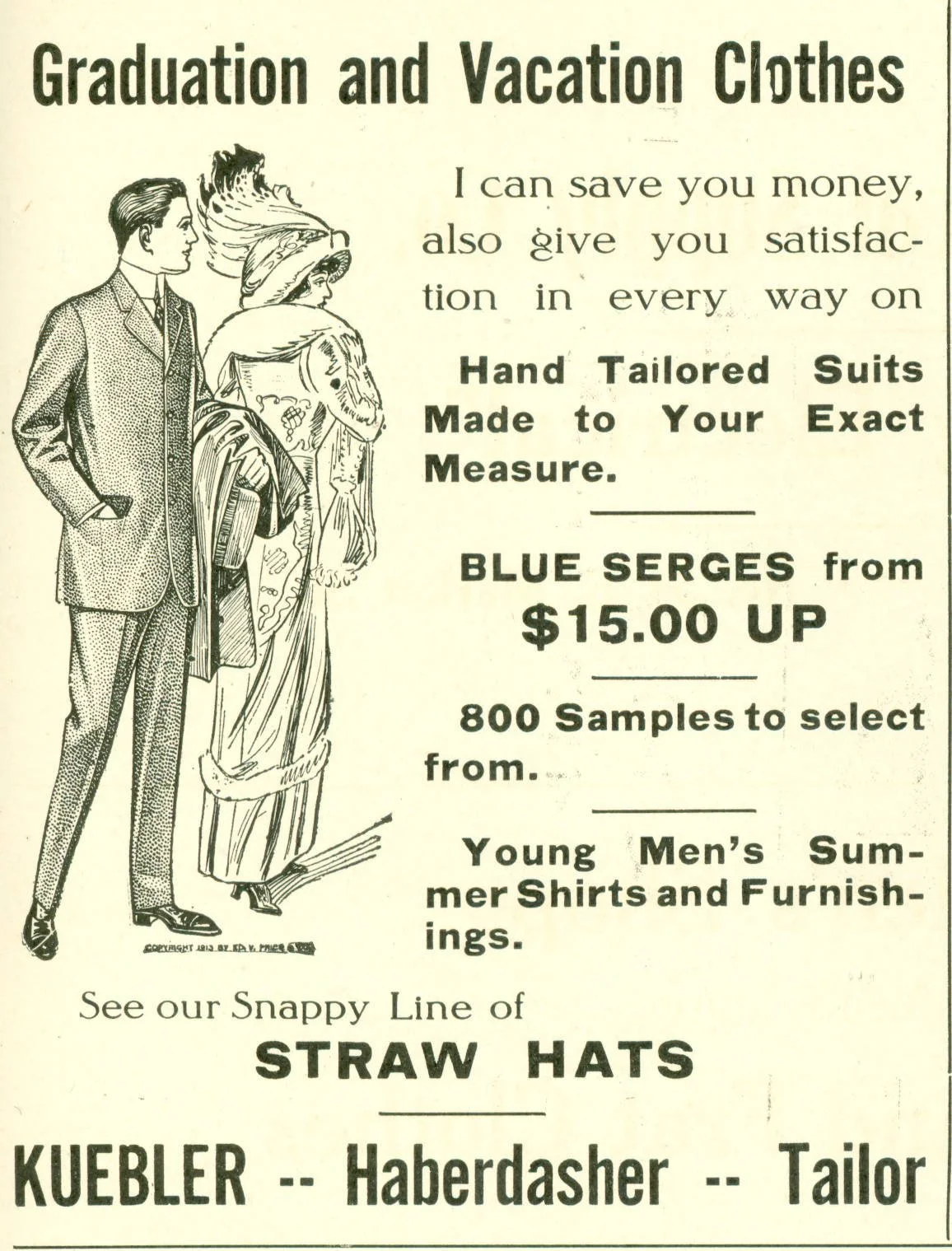
Luckily, if one wanted to buy silks, they only had to visit the haberdashery. Another type of salesman was a haberdasher, who sold linens, particularly for men (see photo of advertisement listed in the Tiffin High School’s Columhi 1914). Haberdashers sold things like neck ties, shirts, belts, hats and other accessories. Today, we would call a haberdasher a “tailor”.
The term “notions” comes from the types of things a haberdasher sold – needles and thread, buttons, zippers, and other small items, perhaps what one would find in a modern-day store like JoAnne Fabrics.
Sawyers are another old profession that had existed since Ohio’s early pioneer days. They used circular saws and gave away the extra sawdust and mulch material. Sawdust was also used for fertilizing potatoes.
In Republic, its history book states that V.R. Cole and Francis Young were the last sawyers to operate a steam sawmill. Steam sawmills, according to Bill Draper of “My Generations,” steam powered saw mills originated in the early 1800s, which sped up the process of cutting wood. “One master sawyer would have as many as five apprentices,” he explains, as the job of a sawyer was “semi-skilled.”
While sawyers worked with wood, teamsters worked with horses. During the mid-1800s, this was a typical job, even in Tiffin. “Tiffin: A Station on the Underground Railroad” lists not only “a chap named Hall with a very fine team of big horses who was industrious,” but also barbers and draymen as potential jobs, as well as hotel porters, shoe shiners, and plasterers.
The Teamsters Union Local #231 shares that the term “teamster” was typically applied to drivers of horse-drawn wagons who delivered goods. “The typical teamster labored 12-18 hours a day, seven days a week, for an average of $2 per day while assuming the liability for bad accounts and lost or damaged merchandise.” Today, a teamster would align with our society’s wealth of Amazon, UPS and Fed Ex drivers.
And just as many professions have unions, many teamsters banded together in the late 1800s to form the Team Drivers International Union with over 1700 members.
This is just a sampling of the evolution of a few obsolete jobs that once existed in Seneca County, but to find others, visit https://occupationalinfo.org/dot_h1.html.
Works cited:
Bascom Garden Club. Bascom Then and Now. 1976. Seneca County Digital Library. https://ohiomemory.org/digital/collection/p15005coll27/id/29193
Tiffin High School. Columhi 1914. Seneca County Digital Library. https://www.ohiomemory.org/digital/collection/p15005coll27/id/24850/rec/11
Scipio-Republic Historical Society. History of Republic Ohio. 1989. Seneca County Digital Library. https://www.ohiomemory.org/digital/collection/p15005coll27/id/33590/rec/3
Gundlach, George. “Tiffin: A Station on the Underground Railroad.” Seneca County Digital Library. 1976. Seneca Sentinel. https://www.ohiomemory.org/digital/collection/p15005coll27/id/50434/rec/2
Hewitt, Jane. Dictionary of Old Occupations. Family Researcher. https://www.familyresearcher.co.uk/glossary/Dictionary-of-Old-Occupations-Index.html#
Wordfoolery. https://wordfoolery.wordpress.com/2024/11/18/the-confusing-history-of-haberdashery/
Keir, Malcom. “The Unappreciated Tin-Peddler; His services to early manufacturers.” University of Pennsylvania. https://www.crazycrow.com/site/tin-peddler/
Teamsters Union Local 231. https://www.231teamsters.org/?zone=/unionactive/view_page.cfm&page=Teamster20History
Draper, Bill. “Interviews with English Sawyers”. My Generations. 2016. https://billdraper.net/html/body_sawyers.html