
By Emily Rinaman, Catalog Librarian
A crocheted blanket is often a souvenir for families of loved ones who have an extended day at the hospital. These blankets are often stitched by small groups of individuals who enjoy knitting and crocheting as a hobby. This, however, is not a new phenomenon. Girls often learned needlework at a very young age (5-6 years old). They would start out embroidering “samplers” of alphabet and numbers. Making samplers continued into adolescence until the young woman could graduate from simple samplers to more complicated ones. They were also taught to sew blocks that would be made into quilts.
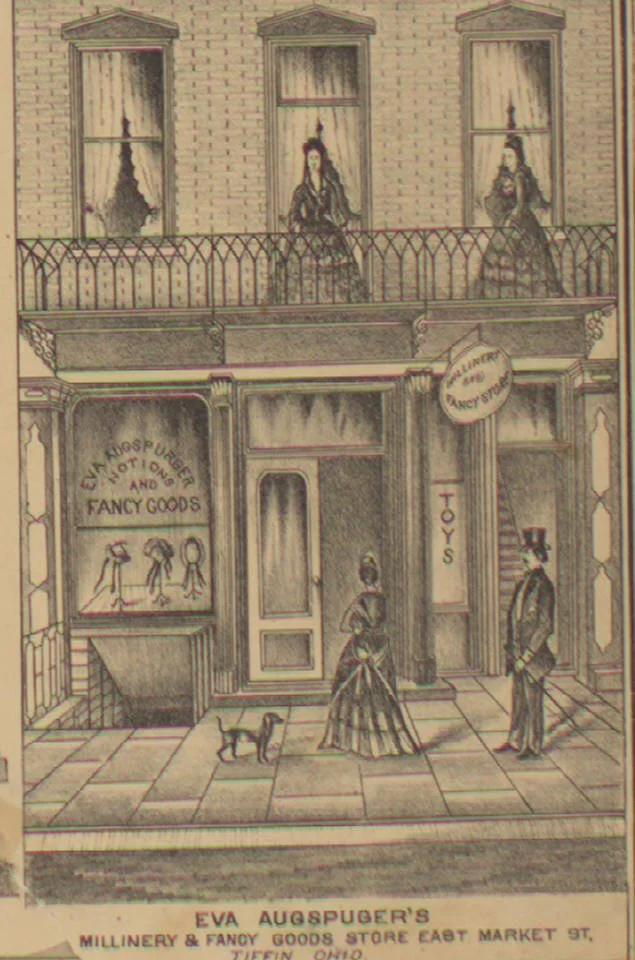
Martha Gibson of Seneca County says a Mrs. L. gave her several blocks “with the request that I should add enough to it for a quilt.” While this young woman confesses that it took her many years to finish, when she finally did, her children always asked for the “star quilt” when they were sick and wanted to be entertained by the stories of the fabric used in the quilt (pieces from the dresses of the maker’s mother and sister).
Many groups of people, particularly women, have been meeting to sew, knit, crochet, and embroider together for decades. In Seneca County these groups of like-minded individuals were common. Not only did the Young Ladies Embroidery Club in Bloomville make projects together, but they also cleaned different rooms of the building where they were hosted.
Quilts, unlike needlework, are often a conglomerate of blocks that can be stitched by different individuals, which makes a quilt so unique.
In Bascom, a quilt was made as a “final farewell” to an old school building before it was no longer used:
“To honor Mrs. Shelt the group presented her with a quilt. The blocks were made by the different families, with the members names stitched in them. Except for the middle block, it was a picture of Hopewell Center School, drawn by Madeline Haugh and stitched by the Swartzmiller Sisters of Tiffin.”
At one time, during the 1930s, it was reputed in “Bascom Then and Now that “every church and organization in Bascom was at sometime or another slaved to the ‘quilting business’.”
Another group in Omar had made a quilt in 1910 for a church fundraiser. The story goes that there were 400 names to be placed on the quilt – far too many to embroider, so a local printer used his printing set to place the names on the quilt. The ladies of the society, however, said the pieces “looked like salt sacks and finishing the quilt was postponed indefinitely.” Several years later the group picked the quilt back up and it was eventually donated to the Attica Area Historical Society.
Later, when the war began, efforts were made to make blankets and such for soldiers on the front. A second purpose to these groups was suffrage. Going back to the sampler example, however, one author states that groups could now embroider political messages on handkerchiefs. “Knitting for Victory” events became popular, states the Providence Journal.
Ladies Aid Societies and Red Cross volunteers would also knit woolen socks and mufflers. The 1917 Club in Omar would often make rugs for its hostesses. This group, which began by a different set of women, made a quilt for a Red Cross nurse. These groups often survived after World War I.
In Omar, the H.H.M. Club was organized in March 1918 by five women, “banding together good neighbors”. Not only did the group finish needlework, but it also provided a sense of companionship during difficult times. The group sang and performed recitations.
Needlework, while still displayed at county fairs, was must more plentiful as an art during the late 19th century and early 20th century. At the 1870 county fair in Seneca County, over 150 items of needlework and a Singer sewing machine were on display. We don’t see those kinds of numbers today, sadly, but we still cherish the treasures our ancestors made.
Works cited:
Bascom Garden Club. “Bascom Then and Now”. 1976. Seneca County Digital Library. https://ohiomemory.org/digital/collection/p15005coll27/id/29193
Gibson, Martha. “Reminiscenes of Early Days of Tiffin”. 1967. https://ohiomemory.org/digital/collection/p15005coll27/id/12997
Barnes, Myron. “Between the Eighties, Tiffin, Ohio 1880-1980”. Seneca County Digital Library. https://ohiomemory.org/digital/collection/p15005coll27/id/65422
Lepard, Larry. “Omar: A Community of Memories”. https://ohiomemory.org/digital/collection/p15005coll27/id/41429
Smith, Howard. “What, How and Who of It: An Ohio Community in 1856-1880”. 1997. https://ohiomemory.org/digital/collection/p15005coll27/id/16074
Peck, Amelia. “American Needlework in the Eighteenth Century.” The Met. 2003. https://www.metmuseum.org/essays/american-needlework-in-the-eighteenth-century
Petronella, Elin. “History of Embroidery and its Rise in Popularity.” Charles&Elin. https://www.charlesandelin.com/embroidery-blog/history-of-embroidery-modern-art-form
Lindsey Schier. “Local groups made sewing kits for soldiers.” 2018. Des Moines County Historical Society.