
By Emily Rinaman, Catalog Librarian
It’s the holiday season and Santa Claus has got a toy for every good girl and good little boy, sings Andy Williams in the classic Christmas carol, “Happy Holidays”. But what kinds of toys does he have in his “big fat pack upon his back?”
The types of toys given to children on Christmas morning has drastically changed over the years and decades. There was a time not that long ago when Christmas morning was a much more peaceful affair before toys were battery-operated, creating noise and flashing lights.
In “olden times” some of the most popular toys were dolls, marbles, dominoes, and building toys, such as tinker toys or erector sets.
The first mass-market marbles were an Ohio product. The S.C. Dyke & Co. in Akron started producing clay marbles in 1884. Once they grew in popularity, but the end of World War I, other manufacturers debuted the more modern marbles we all are familiar with today and porcelain and glass replaced clay because these materials allowed for more colorful creativity.
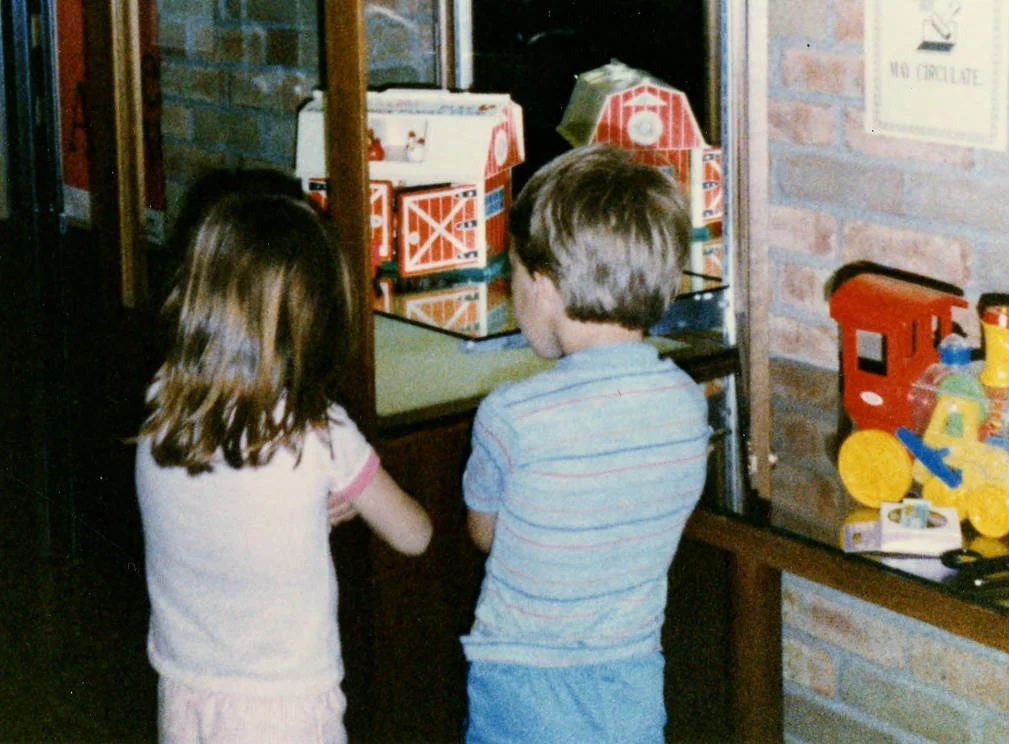
A couple of children look at a Fisher Price toy barn that was part of a toy display in the Tiffin-Seneca Public Library in the late 1980s.
Charles Otis Locke, a member of the Locke family in Tiffin who managed the Tiffin Tribune from the 1860s until the early 1900s, wrote in his essay collection, “On a Shop I Once Knew,” which has been digitized on the Seneca County Digital Library, that the shops in Tiffin were “filled with many boxes of marbles ranging from the little white pellets called ‘commies’ to the great brown and blue ones, the agates and glass alleys, with spiral streaks of red, green and blue in them.”
Manufacturing marbles reached an all-time peak in the 1940s, producing over two million marbles per day. While glass and porcelain was more expensive than clay, the price for marbles was still relatively low.
In addition to wind-up pocket watches, gloves, tinker toys, erector sets and roller skates, Junior Home kids could choose a set of marbles as a gift at Christmas. One Junior Home kid remembers marking his top three most desired objects from a list of around one dozen items. “The instructions were to select three in the order of their important to you, because you would get only two. It was clear that if one of the first two presents was unavailable, the third choice might be honored,” he wrote in the December 1991 Junior Home Kid newspaper.
Many of the Junior Home Kids preferred tinker toys, which became a hit around the same time that glass and porcelain marbles took off. Tinker toys debuted in a window display at Marshall Field’s in Chicago. In addition to the traditional locations where toys were sold, Tinker Toys were also featured in the windows of corner drug stores, dry goods stores, even stationary and cigar stories.
Joseph Buckley, another Junior Home graduate, recalled in a Letter to the Editor in December 1954 that he remembered during his time spent at the Home that his fellow classmates requesting footballs, harmonicas, wrist watches, boots, pencil sets, traps, jumping ropes and tinker toys on the Home’s Christmas wish lists.
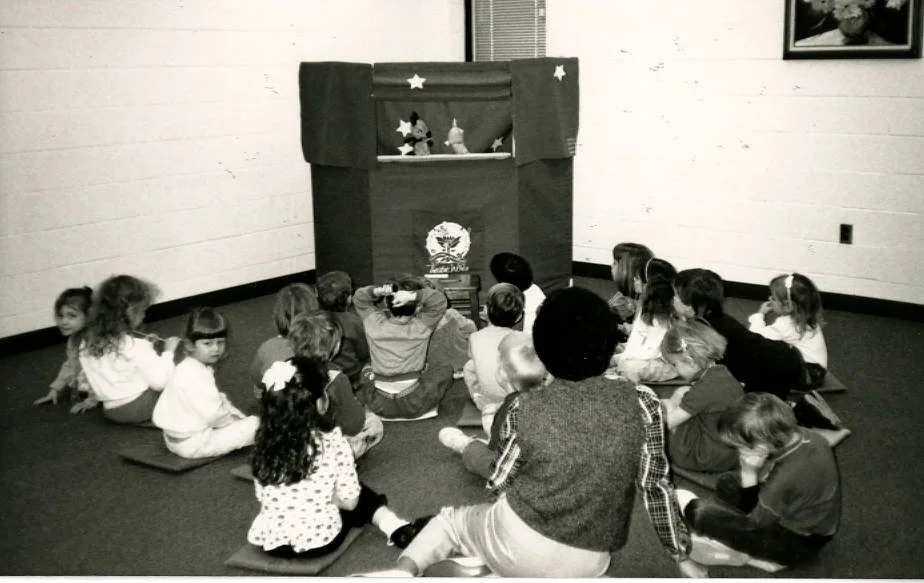
Children watch a puppet show at the Tiffin-Seneca Public Library in the early 1990s. In their many forms, dolls have remained one of the most iconic Christmas gifts for decades.
One stark difference in old-fashioned toys compared to the options available to young children today, is how simple yet interactive toys once were. Marbles, jacks, tinker toys or dominoes could be played alone, but are more enjoyable and fruitful when played in a group setting.
The Melmore High School Class of 1943 explained in its 50th class reunion commemorative scrapbook (also digitized on the Seneca County Digital Library) that they would play dominoes, rook and the card game Old Maid next to a wood-burning stove and eating popcorn. Junior Home Kids would play dominoes on cold or rainy days, build items out of their Tinker toys, or play the card games “Hearts” or “Pinochle.”
Dolls have long been the classic Christmas gift for girls, from corn husk dolls and rag dolls to china dolls. In 1931 when the Great Depression was raging, the Tiffin Boy and Girl Scouts held a Christmas party for 500 “needy children”, which included showing a full-length movie at the Grand Theater. All of the attendees received candy and while the boys received an unspecified toy, each girl received a doll.
In 1945, the Dramatic Club at Tiffin Columbian performed a play called “The Toy Shop”. Students acted as a masked doll, wooden doll, French doll, sailor doll, rag doll, and a Pierrott Doll (plus a jack-in-the-box on the side).
Dolls were so popular in the early to mid-1900s that an ordinance was passed in New Riegel which specifically allowed baby carriages and toy wagons to be pushed and pulled on the sidewalks, but disregarded bicycles and tied-up horses.
Regardless of the toy, there’s no doubt that the toys produced in general throughout the 19th and 20th centuries provided children with vivid imaginations and social skills.
Works cited:
Bascom Area Sesquicentennial 1837-1987. https://ohiomemory.org/digital/collection/p15005coll27/id/41947
Buckley, Joseph. Letter to the Editor, Advertiser-Tribune. Dec. 26, 1954. https://ohiomemory.org/digital/collection/p15005coll27/id/47332
Junior Homekid newspapers. Seneca County Digital Library. https://ohiomemory.org/digital/collection/p15005coll27/search/searchterm/Junior%20Homekid
Locke, Charles Otis. On a Shop I Once Knew. https://ohiomemory.org/digital/collection/p15005coll27/id/44268
Melmore High School Class of 1943 50th Class Reunion Commemorative Scrapbook. https://www.ohiomemory.org/digital/collection/p15005coll27/id/29728/rec/1
Seneca County Museum newsletters. Seneca County Digital Library.
Seneca County Digital Library, Ohio Memory Project, https://www.ohiomemory.org/digital/collection/p15005coll27/search
Tiffin-Seneca Public Library. Puppet Show. https://ohiomemory.org/digital/collection/p15005coll27/id/51370
Tiffin-Seneca Public Library. Kids at Toy Display. https://ohiomemory.org/digital/collection/p15005coll27/id/51345
Tiffin Columbian High School. Blue and Gold, 1945. https://ohiomemory.org/digital/collection/p15005coll27/id/4180