
By Jessica Hoehn, Local History and Genealogy Specialist
Many soldiers of the Revolution left their hometowns after the war for new areas to lay down roots. Some of these soldiers eventually found their way to Ohio, often bringing their families with them to settle in the (at the time) new state. This year, we’ll take a look at the soldiers who settled in Seneca County and learn more about them.
For April, we’re focusing on Frederick Shawhan/Shawn. Let’s see how Frederick went from being a shoeless soldier, to the father of Tiffin’s first millionaire.
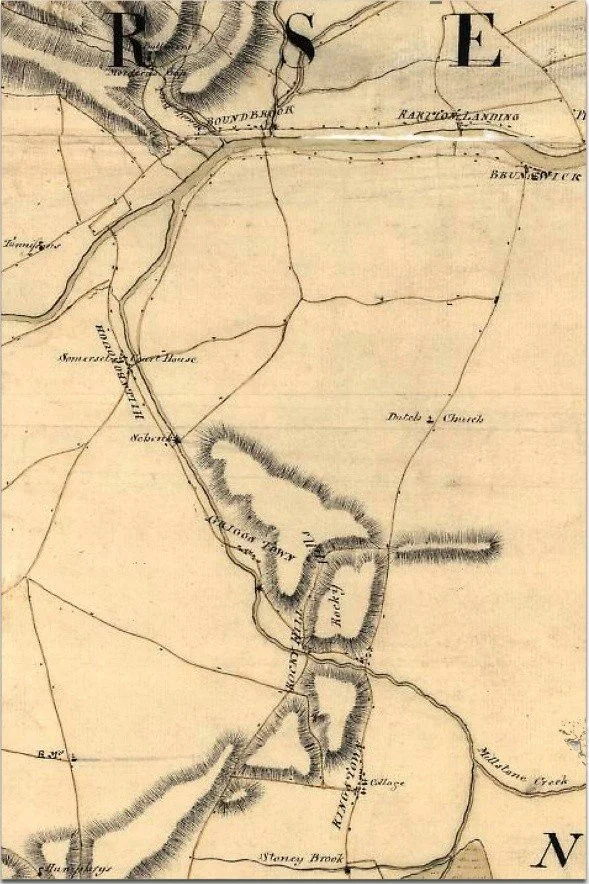
Revolutionary era map showing the towns leading to Somerset Courthouse. (Kingstown, Griggstown)
Born August 12, 1760 in Kent County, Maryland, Frederick’s parentage is somewhat contested. Shawhan family historian, Ronald T. Shawhan, seems to have the most plausible theory. According to “The Descendants of Frederick Shawhan”, he is most likely the son of David Shawhan, a soldier of the French and Indian War, and Jane Greenwood, who never married.
Frederick entered into service on January 8, 1777 in Chestertown, Maryland as a private for a term of three years. He joined the 5th Maryland Regiment under Colonel William Richardson.
In the beginning of his service, Frederick marched to Philadelphia in order to collect arms and clothing. Soon after, he was sent to Griggstown, New Jersey, where his regiment stayed until the British advanced on the nearby town of Millstone. It was here that Frederick saw his first fight in the Battle of Somerset Courthouse.
After the battle, he and the other soldiers were given a ration of flour from a nearby mill. According to his pension file, “I kneaded mine in my hat and baked it on a stone.” Later on, Frederick would see battle again during the Battle of Staten Island. There, he was part of Sullivan’s retreat, and was later ordered to meet the British coming to the Chesapeake Bay. While marching, he became ill and was sent to recover in a Quaker Meeting House near Wilmington, Delaware. Once he had recovered, Frederick then set out to join his regiment in Philidelphia.
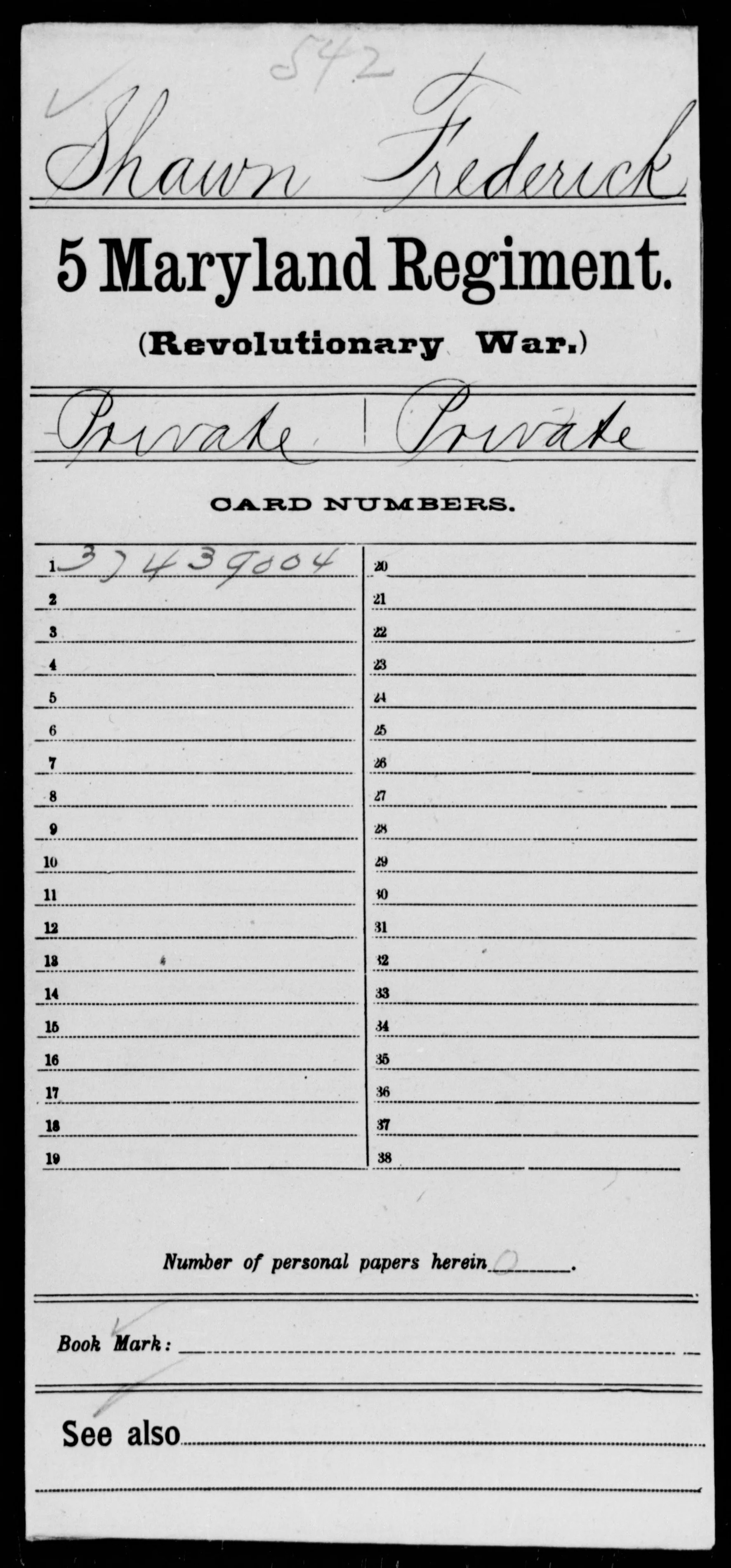
Frederick Shawhan’s Muster Roll, sourced from his pension file.
Frederick’s next battle was as part of a supporting batallion of soldiers during the Battle of Monmouth, where he witnessed the British retreat. Next, he was made to guard three American deserters as they were put on trial, though this was only briefly. His next action saw him join the fight at the Siege of Stony Point, and lastly, Paulus Hook. In his pension application, Frederick went into great detail about his last battle, remembering it well after many decades had passed.
“On our march, we came to a marsh, and 24 of us who were in front ordered to fall off our shoes that they might not make much noise or being filled with water. I would with alacrity have obeyed the order, but not having any shoes on me first I was excused. The bridge being up, we waded more than waist deep, we got through the picket gate, sealed the wall, took all the money with them at barracks, and marched off with them before light.”
Over the years, Frederick spent the winters and some springs encamped in several places with his regiment. His first camp mentioned near Wilmington, the regiment marched (with Frederick barefoot) over the Schuylkill River on a bridge made out of wagons. The following spring, they moved camp to Valley Forge, where the reigment was later detached to intercept the British at the Delaware River.
Frederick also camped with his regiment for the winter at Bound Brook, New Jersey. In the following Spring, he was detached under General Charles Scott in White Plains, and served under him for four or five months around Kingsbridge, New York, with no battles mentioned.
After his time was up there, he rejoined his regiment to over-winter one last time near Morristown, New Jersey. There he was detached to a factory, and spent the last of his service making clothes for soldiers. He was discharged from service January 8, 1780, and given an order for 14 days rations.
After the war, Frederick lived in his home county of Kent for 13 years. From land records, he may have worked as a tailor during this time. While in Kent County, according to Shawhan family historians, he married his first wife Elizabeth Allen. They had several children together, and around 1793 the young family moved to the other side of Maryland, settling in Washington County around the Potomac River, for about four years. It was there that Elizabeth died around 1796.
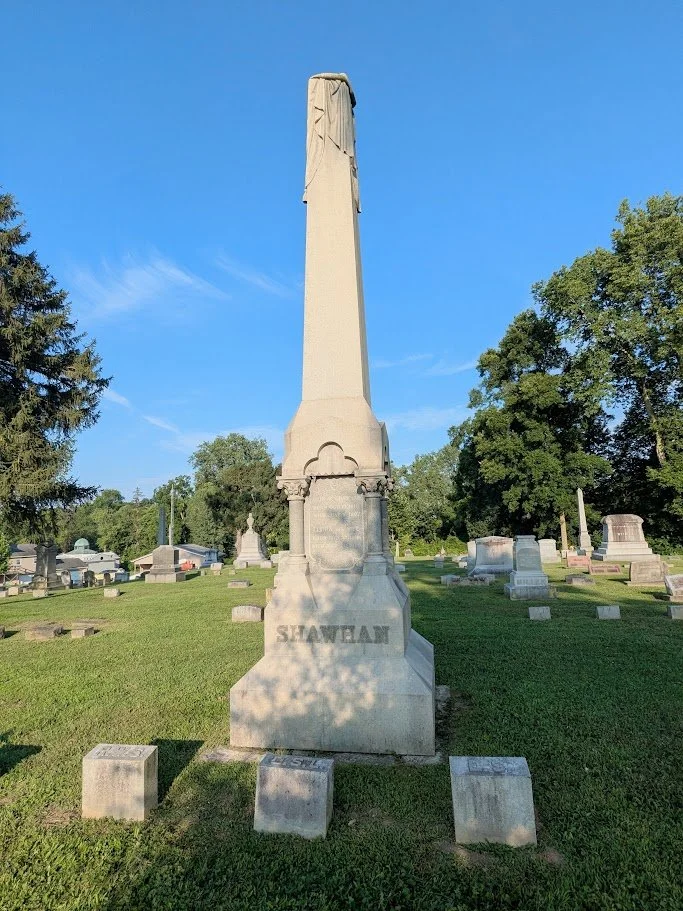
The Shawhan family monument. Greenlawn Cemetery, Seneca County, Ohio.
Marriage records show that he was married again to Eleanor Wells in Washington County on July 12, 1799. This would be after he claims to have moved to Back Creek in what is now Berkely County, West Virginia, so his recounting of his journey to Ohio may be slightly off. He lived next to the creek for about 15 years with Eleanor, having about eight children together, and raising the four from his previous marriage who had lived past infancy.
Next, he and his family made the trek to Ohio! Here they would live in several places, starting with Fairfield County. There, he settled near the city of Lancaster on the banks of the Hocking River for around five years. According to family history documents, it was here that Eleanor unfortunatley passed away in 1815. A few years later, Frederick would move to Wayne County, spending about thirteen years settled there before packing up once again and moving on to Richland County for about two years.
He next moved on to Perry Township in Wood County, where he was allowed his pension claim on October 3, 1833. We don’t know exactly when he moved next, but by 1840 Frederick was living in Seneca County! He lived in the home of one of his younger sons, Lorenzo Shawhan, a pioneer businessman of Tiffin, and stayed there until his death on August 8, 1840 at the age of 80. He is buried in Greenlawn Cemetery with many of his descendants.
You may recognize the Shawhan surname from one of our more famous citizens, Rezin Shawhan! He was Frederick’s youngest son with Eleanor, and settled here in 1832 after leaving home in Fairfield County. He became Tiffin’s first millionare, starting several businesses in town, some with his brother Lorenzo, and had some rather iconic buildings named after him, including the Shawhan Hotel. Rezin’s house here in Tiffin is actually the home of the Seneca County Museum! Without Frederick and his family, Tiffin certainly wouldn’t be the same.