by Jessica Hoehn, Local History and Genealogy Specialist
Many soldiers of the Revolution left their hometowns after the war for new areas to lay down roots. Some of these soldiers eventually found their way to Ohio, often bringing their families with them to settle in the (at the time) new state. This year, we’ll take a look at the soldiers who settled in Seneca County and learn more about them.
For June, let’s learn about Robert Carson. Born on May 7, 1762 in Sherman’s Valley, Cumberland County, Pennsylvania. The area is now a part of Perry County, named after Commodore Perry in 1820. His father was David Carson, and his mother’s name is unknown. Years before Robert’s birth, Sherman’s Valley saw violence from altercations with Indigenous peoples in 1755 and 1756. Attacks again happened in the summer of 1763, causing many settlers to flee the valley. One can only imagine what it may have been like for young Robert to grow up surrounded by such uncertainty.
Once war had broken out with Great Britain, Robert was still a young boy of 13. His father, David, ended up joining a militia and fighting for the United States, probably sometime around the start of the war. In mid-August of 1777, Robert claimed to have ended up doing the same at the young age of 15, serving as a substitute for his father.
During his first service, he enlisted as a private in what, according to militia records, was most likely the 2nd Company in the 7th Battalion of the Cumberland County Militia. His superior officers being Captain James Powers and Colonel Mitchel. According to his pension file, Robert joined his company at Carlisle, a borough in Cumberland County, Pennsylvania. He recorded that during his roughly five and a half months of service, his company had encountered a British light cavalry regiment whilst marching from Reading. Apparently, the two units scrimmaged, with Robert saying of the British;
“…indeed one of their horses was shot down, and the rider was shot through the knee.”
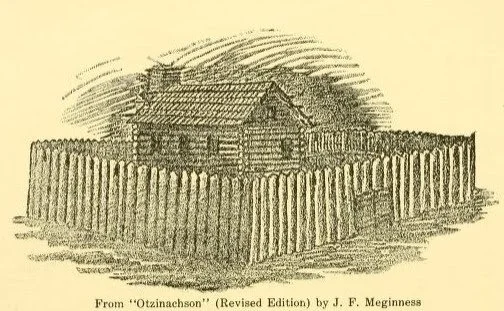
Afterwards, his company was told that some loyalists to the crown were in Chester, the oldest city in Pennsylvania. According to Robert;
“we went to Chester after night and stole past the British sentinels and went to the house where these men were and found them engaged in playing cards. The…said Capt. and the rest of the company went in and took the men. They tied their hands behind their backs, and we got out again past the guard without being discovered by any one except the landlord.”
Later in his service, Robert was out scouting with his company around the Schuylkill (presumably the large river in Pennsylvania), when they encountered the British once more. Robert and his company fired on the guards, who fired a cannon back, which struck a nearby house.
Robert claims he was next drafted on the first of May, 1778 until September of the same year, days before he turned 16. He rejoined the 7th Battalion, though this time being sent to the 1st Company under Captain James Fisher. The company was sent to protect the settlers living along the Chillisquaque Creek at the time, remaining there until word was sent that British forces were attacking Fort Freeland. They set out to meet the British there, but before they could get to the fort, it had been taken and set on fire.
It is this author’s belief that Robert misremembered the year of his second enlistment, as Fort Freeland wasn’t witness to a large-scale attack and destruction until July of 1779. As such, it is most likely that Robert enlisted in the Spring of 1779, when he was nearly 17. It is also of note that he seems to misremember his battalion number, as he reported he was in the 8th, when all his superior officers were members of the 7th. This is most likely due to his advanced age upon applying for his pension.
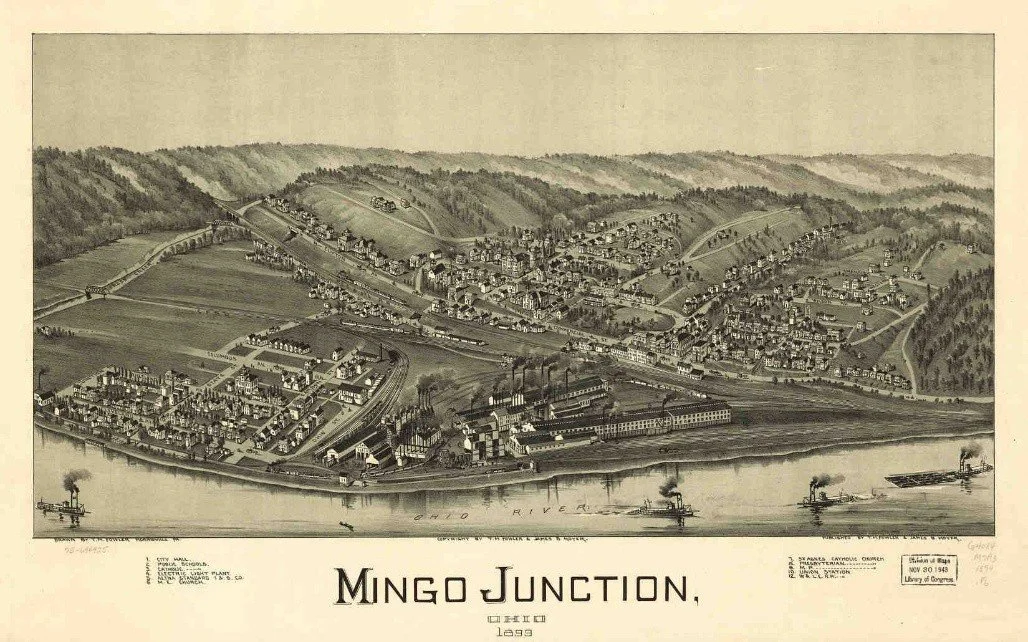
After his two terms had ended, Robert stayed in Sherman’s Valley with his father until about 1780, when he moved to Washington County, Pennsylvania. At some point in his life, he married his wife Margaret and started a family, though we are unsure as to when. In 1791, he and his family moved to Wellsburgh, Virginia, now a part of West Virginia. They only stayed here for three years though, as ultimately in 1794 Robert and his family decided to move and become early settlers of Ohio. That year, they settled around Mingo Bottom, a part of Jefferson County. Jefferson was one of about four counties in Ohio at that time, and covered much of the eastern part of the territory. The area of Mingo Bottom is known today as Mingo Junction, and is still a part of Jefferson County. Whilst living here, Robert was recorded as having hunted several wolves in 1806 and 1808 for their scalp premium from the county.
Robert stayed near Mingo Bottom for about 16 years, moving to what would soon become Franklin Township of Harrison County in 1810. Its here that he applied for his pension on September 18, 1834, but had his claim rejected. The official reasoning was for his inability to prove 6 months of service to the country. This is likely due to his misremembering of some crucial details of his enlistment.
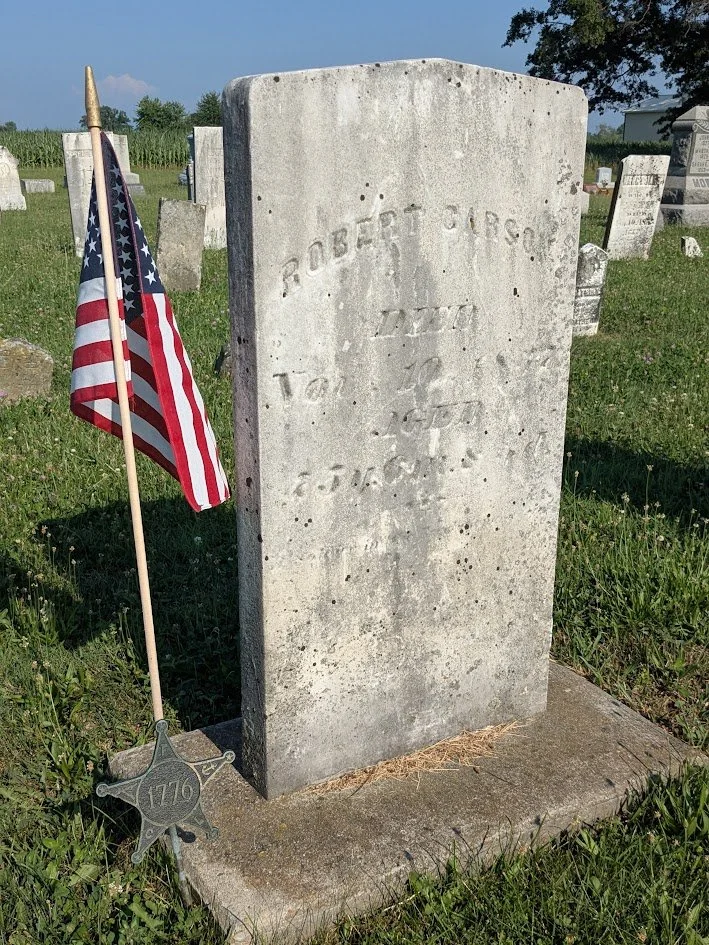
Robert Carson’s grave.
Swamp/Union Pisgah Cemetery, Attica, OH
Unfortunately, we don’t know when Robert, Margaret, and some of their children ended up settling here in Seneca County. Their children could have come here first, with their parents following for support in their golden years, as many others did. Ultimately though, we can’t say for sure. Margaret died on May 2, 1837, and it is said that she was the first buried in Swamp Cemetery (a.k.a. Union Pisgah Cemetery), south of Attica, when the area was still tree-covered. Robert followed his wife only a few months later, dying November 10, 1837 and was interred alongside Margaret.
While we don’t have a lot of information about Robert’s personal life, we do know that his descendants inherited his attitude towards serving one’s country. It was noted in several newspapers after World War I that multiple generations of Carsons, all buried in Swamp Cemetery, had served in the military. Robert’s son Samuel was a veteran of the War of 1812, grandson Tarleton a veteran of the Civil War, and great-great grandsons Robert and Lloyd served in the first World War. There are other branches of the Carson family, many of whom are veterans, buried elsewhere throughout the county and beyond.