
Many soldiers of the Revolution left their hometowns after the war for new areas to lay down roots. Some of these soldiers eventually found their way to Ohio, often bringing their families with them to settle in the (at the time) new state. This year, we’ll take a look at the soldiers who settled in Seneca County and learn more about them.
This August, let’s learn about William Harris. He was likely born October 10, 1762 in Harrisburg, Pennsylvania to Samuel Harris and Elizabeth “Betsey” Bonner. William’s home city was actually founded by his uncle, John Jr., and later became the state’s capital in 1812. At some point after his birth, the Harris family moved to the town of Sunbury, in Northumberland County, Pennsylvania. Samuel notably served in the French and Indian War, and when war broke out once more in 1776, he was made a captain of the cavalry in Pennsylvania. A young William ended up following his father into the military.
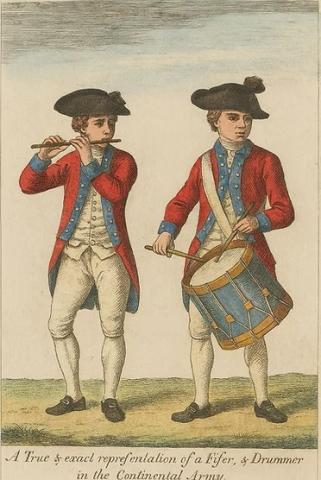
William volunteered into the service around the winter of 1776 at Sunbury for 3 months under Captain Hugh White. Being just a child at the age of 14, he was made a fifer, which is how many young boys who followed their fathers to war served. Fifers were integral on the battlefield, using their music to relay orders to the many men on the front.
While serving as a fifer, William and his company marched through the city of Trenton just 6 days after Washington’s famous Delaware crossing, in which he attacked the Hessians camped there. He also witnessed a skirmish set between the settlements of Millstone and Morristown. Based on his testimony and the timing of his service, the fight he described may be the Battle of Millstone. After his term as a fifer was up, William waited to enlist again until the spring of 1781 at the age of 18.
This time, he was made a private and Indian spy under Captain Peter Grove for seven months. As an Indian spy, it was William’s job to act as a scout on the edge of the American frontier. He would watch for signs of incoming raids on settlements, as well as report on notable tribal movements.
After the war, William moved from Sunbury, Pennsylvania, to Tioga Point on the Susquehanna River. Today, this is now the borough of Athens, Pennsylvania. Here he stayed for 3 years, before moving to live somewhere along the shores of Cayuga Lake in New York. While we don’t know for sure, he may have decided to move there to live near his father, who had emigrated to the lake in 1795.
He didn’t stay there for long though, as soon after settling at the lake, he moved to live along the Genesee River in Livingston County, New York. It is while living there that William served in the War of 1812. While at this point he couldn’t serve on the front, like his sons Augustus and Samuel reportedly did, he was able to take part in the manufacturing of bullets for those fighting.
One event that occurred well before the War of 1812, was his marriage to Mary Mead. We sadly don’t have access to any record of when they were married, so whether it was in New York or Pennsylvania, it’s hard to say. Together, the two would have a total of 10 children, many of whom would eventually join the couple to live in Ohio.
Later, in 1818, William and his family would pack up and move once again across the state border to Meadville, Pennsylvania. There they would only stay briefly, as according to local history books, William would arrive at Fort Seneca here in what would soon become Seneca County in 1819. He would send for his family, including some of his grandchildren, to join him a year later in 1820. It’s near the fort that William decided to live here permanently, making him one of the 110 pioneer settlers in the county at the time!
William was able to make a good living for himself in the area, as he was a talented gunsmith. His time as an Indian Spy may have also encouraged him in his youth, as it was recorded that he learned several indigenous languages in his lifetime. According to “Ohio Early State and Local History”,
“…wherever he lived, in Pennsylvania, New York, or Ohio, he had Indians for customers, whose guns he made and inlaid with silver, etc.”
It would be well over a decade later on October 4, 1832 that William would apply for and receive his soldier’s pension as he was turning 70. He would only receive his pension for a few years though, as either in 1834 or 1835, he would die and be buried near Fort Seneca in what would eventually become known as McMeen Cemetery.
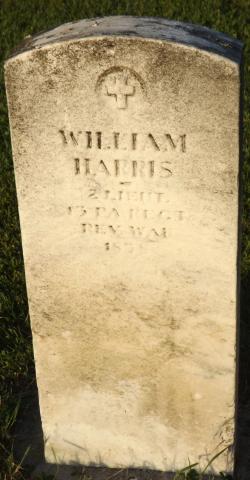
William’s grave is incorrectly marked, putting his date of death as 1838. It also lists him as a 2nd Lieutenant. From sources that were gathered for this post, it doesn’t seem like William ever achieved such a rank, so this may be another error on the stone. As such, he is listed in this article at the rank of Private as described in his pension. His original grave is long gone. In the 1920s it was written that some of the graves in McMeen Cemetery (at the time part of a farmer’s field) were piled against a fence. It is possible that William’s grave was either damaged or worn with time, so that when it was replaced in 1941, the information on it was misread.
After William’s death, his wife Mary applied for and received a widow’s pension in 1836. After this, we don’t know what happened to her, nor where she is buried. As for their children, several of them went on to establish families in Seneca County. This included their daughter Tabitha, who became a well-respected woman in Tiffin, and was among the oldest pioneer residents of the county when she died in 1893.